

attractors & refuges from chaos
I started writing this series because I felt the presence of strong dissonance in most of the conversations I’ve had lately with clients and others, and I wanted to explore alignment as a direction (more on embodiment some other time). Dissonance generally sucks to experience, both emotionally and physically, and can become a sticky cycle in our lives and organizations (Connecting to What We Stand For (1/3)). It’s the opposite pole of alignment, and therefore a temporary state that can be navigated to reach a more balanced one (rather than a problem that can be solved).
Connecting to values is one way I have been taught to start creating conditions to experience more alignment and begin to shape the world I want to live in.1 Beginning to notice and experiment with the sources of our decision making, like values, is no one’s business but our own. It’s a line of inquiry that can shake up our lives, and depending on our context, the stakes of fully engaging with that process might be too high or unappealing altogether (There’s No “Line” in “Alignment” (2/3)).
The potential for lots of learning in the gaps between what we believe, say, and do is always present. For those who choose such an adventure (or have one thrust upon them), how we treat ourselves as we make our way towards more alignment matters. Whether any of it looks like anyone else’s experience doesn’t. It’s probably going to be uncomfortable, but that’s ok, maybe even necessary. Simply part of the territory of trying new things, I’m afraid.
Dedication to noticing, practicing, and experimenting begins to create the conditions for things we want to happen (re: microshifts). Even if it takes a little while to experience the impacts, claiming our innate human agency and integrity sets us up to fly when the moment is right. Whenever I have felt alone in what I care most about, it’s because I was yet to find my people.
Whatever someone’s orientation is to what they care about, it’s still a point for connection. What we care about —really care about — is some of the most nourishing stuff we can connect over and build upon. It’s a powerful attractor that creates more space around the possibilities, a space that often eventually gets filled with more people who share some of our values and therefore a “similar enough” vision to walk toward together.2
I used to simply describe this energy and outcome as “the ripples going out,” and sometimes still do, but since learning more about “islands of coherence”3 and “nutrient islands,”4 and applying them to my work, I can now better articulate to folks how and why the ripples go out using my own definition: islands of coherence are refuges that form when entities (in our case, people) band together to survive extreme conditions. People on these islands are bonded by what they have in common and their community strengthened by their differences. Islands of coherence are the points from which people doing hard things sustain each other. They are also the points from which new things emerge, and the gathering points around which systems shift.
The dissonance we may already experience in ourselves and the world is further fed by chaos, which keeps us stuck in a loop that gets hard to step out of (re: the polarity of dissonance:alignment). Exposure to chaos for extended periods hijacks our nervous and endocrine systems and keeps us in “fight or flight” mode. We’re not ourselves when we’re in that state. We need island refuges from this vicious cycle.
Systems change takes years of collective action, and we’re smack in the middle of some intense transitions. It’s asking a lot of us. The islands of coherence I am on and watch from afar are slowly getting larger, growing and sustaining us in these chaotic times (how the people of the Twin Cities, Minnesota responded to ICE raids is one recent, well-known example).
I have this fierce knowing that one day, the distance between all these islands will shrink as they grow and attract more people. What we stand for will cover more ground, and we’ll be standing more closely together as the islands spread, maybe even merge. I can’t say whether I’ll still be around to see that, but I know that what I do while I’m here can help somehow. New systems are already emerging from how we connect to what we stand for and what we do to those ends. I’m glad to be standing against chaos with y’all.
-Cheyenne
p.s. I was struck (again) while writing this week by how many people and communities of practice I feel honored to credit when I share some of the things I care most about. I’m so glad we’re on an island together. Thank you for being generous with your knowledge and friendship.
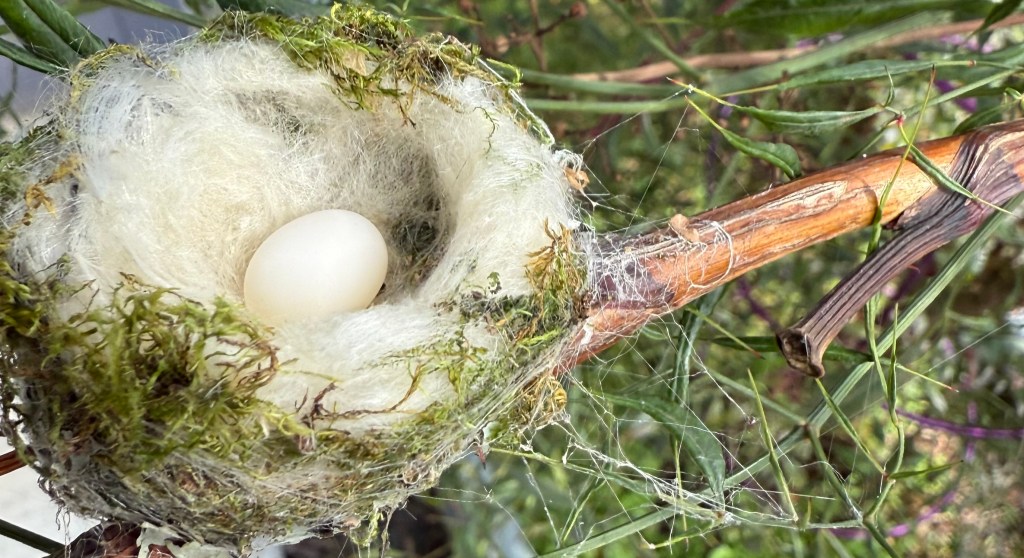
photo: the hummingbird nest from “Just In Case” one day later with an egg. a little gift, like getting to do things we care about together
1 especially through teachings from the Strozzi Institute for Somatics and SomaSJ
2 I like how Loretta J. Ross talks about her experience of connecting with people over “enough” shared values as a foundation for human rights movements, rather than identity politics (for example) because “winning” is more important than “being most correct.” (or never being challenged by people you mostly agree with). Also polarization stinks and keeps us isolated. See “Calling In: How to Make Change with Those You’d Rather Cancel.”
3 The concept of “islands of coherence” is most widely attributed to Nobel-prize chemist Ilya Prigogine, who said, “When a complex system is far from equilibrium, small islands of coherence in a sea of chaos have the capacity to shift the entire system to a higher order.” I learned about them from Janine Benyus and Dayna Baumeister at Biomimicry 3.8. As an ex-biologist who now works with complexity in humans and the systems we create, I am in love with the application of biomimicry to understanding and navigating the problems we create by distancing ourselves from nature and each other. Biomimicry 3.8 and Biomimicry for Social Innovation are leaders in this space.
4 “Nutrient islands” come from ecology, and are the small, nutrient-dense patches of soil that start to accumulate around a chance resource, like a seed transported somewhere in bird droppings. The nutrients in the droppings enrich the soil, which begin to attract microbes and other resources, until, maybe the seed germinates. Many years later, the cascade initiated by that one bird poo may amplify and result in a patch of vegetation, even a forest.


Leave a Reply