

critical context & inviting small steps
I frequently encounter the assumption that experiencing more “alignment” implies that the relationship between what we believe, say, and do is linear and that we must be doing something “wrong” if there’s not a straight line in sight.1 I’m yet to experience or hear about paths to alignment as linear. For anyone out there experiencing lots of direct routes: you might be an anomaly among humans, and I’d love to hear your story.
Anywho, there is a lot that happens in our bodies, brains, and environments that affect the relationships between what we believe, say, and do. It’s one thing to feel clear on values and another entirely to use them to make decisions and then use our bodies to act. The external constraints, emotions, and instincts associated with being human make it tangly. We’re moving through the world in our own complex system as we navigate many complex systems, not to be too meta about it.
Seeking alignment in our lives takes nerve and willingness to be vulnerable in the best of circumstances. The stakes feel high to us when we stand up, speak up, and put ourselves on the line for things we care about. For some people, the stakes are their lives and/or livelihoods, not disappointment, discomfort, and discontent.
I would therefore be remiss not to name our inherently inequitable and judgy world as another key reason why there’s no straight line in alignment. Our basic human instinct to belong is often contorted by racism, sexism, ablism, ageism, classism, homophobia, religious discrimination, xenophobia, and all the other “isms” that make our world smaller and meaner. Shit happens, discrimination is real, and they are both things most humans must navigate to a degree. Some people way more than others.
Spending lots of time reflecting on one’s values and making major life decisions accordingly is a luxury and privilege in the face of threats to one’s literal and/or economic survival. Yes, every human must make compromises and choices in their life — some are forced upon us by circumstance, some by people and systems with power in a given context or situation (i.e., national, cultural, local, professional, familial, relational, etc.). Access to resources, like money, food, water, fuel, shelter, healthcare, information, education, transportation, etc. are not givens or equitable in our societies.
All of this is the critical context in which I offer one way to start exploring the relationship between what we believe, say, and do with the hope of experiencing more alignment (and less dissonance; see “connecting to what we stand for 1/3”). For the sake of my wish to do this, say we are in a place where the stakes feel like disappointment and discontent (which are unpleasant and sometimes heartbreaking). How do we start charting a path?
Whatever our orientation to values may be, we all need different things to thrive in different times of life. Being rigid with values will drive you crazy, so find a way that feels good to you. Think direction, not destination. Recognize them as stars to navigate by rather than as the only valid path from A to B. Don’t rush it. Make friends with them.
Like working within any complex system, creating little low-stakes experiments (“microshifts”) for ourselves is a great way to try new things and take steps towards big changes without risking much.2 That definition is going to be different for everyone, so pick something that feels low stakes to you. I have been advised to try a microshift for at least 2 weeks before reflecting on whether it’s beginning to wiggle something loose.
Examples tend to help when explaining this, so here are a few things I’ve tried when I’ve felt disconnected from community (on my current values list), especially over winter: upping my normal volunteer hours, feeding my favorite people more, lingering to chat after yoga, attending virtual community of practice gatherings, actually talking to people at check out counters. If any of those things didn’t start to make me feel more connected to community, my life would not get worse or fall apart. Based on my experience with microshifts and my life at the time, it worked to have a menu of options to choose from depending on my mood and schedule. If you’re new to this, I recommend working with 1 or 2 at first (rather than “winter Cheyenne’s” 5).
One of my favorite things about microshifts is that they’re a way to start to observe in real time that it is impossible for a pattern to continue exactly as it has before if you begin show up differently (even if it’s micro-differently). Sometimes microshifts have disproportionately large effects on outcomes. Depending on the thing you’re hoping to shift, it may take some time to experience the impact, but that doesn’t necessarily mean nothing is happening.
If you notice some good things emerging or think it needs a little more time, great. Stick with it, and keep adjusting as needed. If not, great. Pick something else to try. The point is that the stakes are low enough that you can keep experimenting without risking much, if anything, including time and energy.
I think the whole “a drop in a bucket” thing is bologna. There’s no other way to get a bucket of water except one drop at a time. Whether small actions are “worth it” is a matter of perspective and patience. The buckets we can fill at a tap on high are not the only ones worth having. In the case of the desire to experience more alignment, there’s no way to do that without taking a step, noticing how that feels, observing what happens, then deciding where to step next.
-Cheyenne
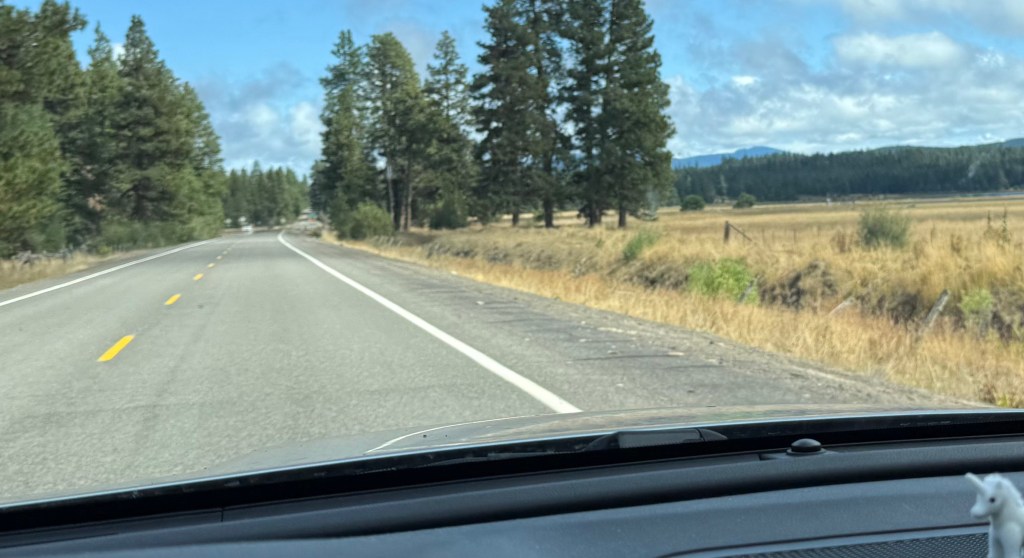
photo: a long detour/wander that resulted in a good day during a period when the distance between values and outcomes felt long
- When I say “alignment,” I mean “more connection to purpose,” not something rigid or linear. ↩︎
- Chris Corrigan and Caitlin Frost of Harvest Moon Consultants have great teachings on using microshifts to navigate complexity and shape the cultures we’re in/of. ↩︎


Leave a Reply